The Solar Corona


The Solar Corona, 2nd Edition


Order The Solar Corona 2nd Edition at Amazon.com

The Solar Corona


 by Leon Golub and 
Jay M. Pasachoff

The second edition, published in 2009.
Only a hardcover edition is available.

Cambridge University Press, http://www.cambridge.org/9780521882019

Hardback (ISBN-13: 9780521882019)


 Table of contents:

 1. Introduction
 2. Brief history of coronal studies
 3. The coronal spectrum
 4. The solar cycle
 5. Ground-based observations
 6. Observations from space: I. The first 4 decades
 7. Activity of the inner corona
 8. Observations from space: II. Recent missions
 9. The solar wind
10. Solar flares & the corona
     Notes; references; index

Order from:

Cambridge University Press (01223) 312393
Publishing Division fax 01223 315 052
The Edinburgh Building
Shaftsbury Road
Cambridge CB2 2RU, England

or in the U.S. from:
CUP, 40 W 20th St, NY, NY 10011-4211 212 924 3900
fax 212 691 3239
www.cambridge.org


See also the Updates/Errata page for this book:
http://www.williams.edu/Astronomy/corona_updates.html

A variety of solar information, including updates on sunspots and daily images through various filters, is available through the homepage for Pasachoff'sAstronomy: From the Earth to the Universe.


Updates

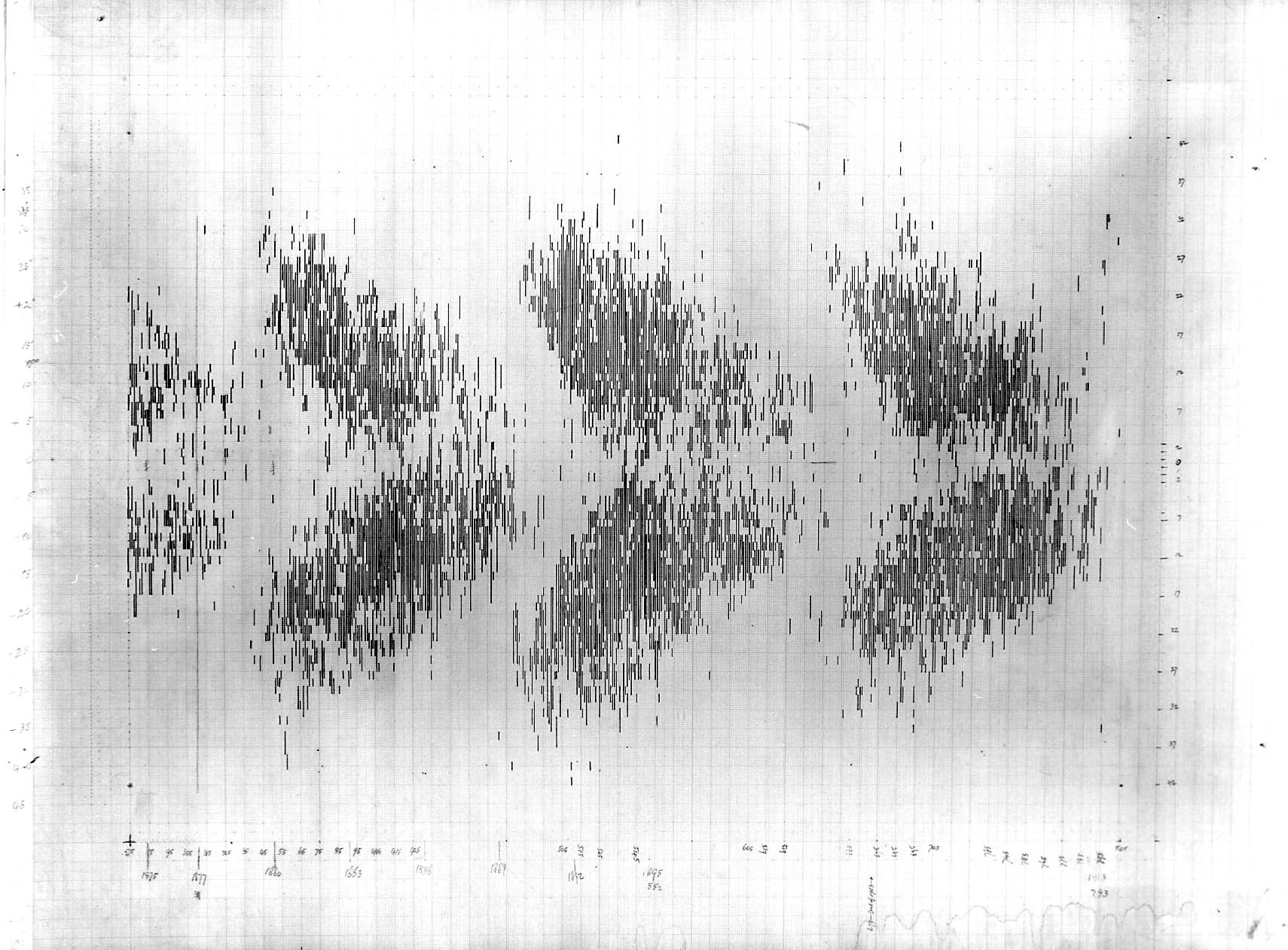
The Original Maunder Diagram


The original butterfly diagram drawn by W. Walter Maunder and Annie S. D. Maunder
in 1904 has been on display for some time at the High Altitude Observatory in Colorado.


National Solar Observatory/Sacramento Peak Coronal Scans on the Web

The National Solar Observatory at Sacramento Peak announces the resumption of posting of daily coronal scans and maps on its web page at http://www.sunspot.noao.edu/CORONA.

Web sites:
International Astronomical Union Working Group on Eclipses:
http://www.eclipses.info


Pasachoff's eclipse expeditions from Williams College and elsewhere:

http://www.williams.edu/astronomy/eclipse

References:

Leon Golub and Jay M. Pasachoff, Nearest Star: The Exciting Science of the Sun, Harvard University Press, 2001.http://www.williams.edu/Astronomy/neareststar

Leon Golub and Jay M. Pasachoff, The Solar Corona, Cambridge University Press, 1998. http://www.williams.edu/Astronomy/corona

Jay M. Pasachoff and Alex Filippenko, The Cosmos, Brooks/Cole College Publishing, 1998. http://www.williams.edu/Astronomy/cosmos = http://www.solarcorona.net


Solar Constant On-Line

The latest values of the solar constant as measured by the VIRGO experiment on SOHO, along with past measurements from several spacecraft, are available on line at
http://www.pmodwrc.ch/solar_const/solar_const.html from the World Radiation Center in Davos, Switzerland.

or, as measured by NASA's ACRIM3 experiment on ACRIMsat, at

http://www.acrim.com

TRACE Satellite

The Transition Region and Coronal Explorer (TRACE) spacecraft, launched in April 1998, makes high-resolution observations of these regions of the outer solar atmosphere. TRACE Web sites are at Lockheed and at the Smithsonian Observatory.

Eclipse, Satellite Solar Slides

Eight radial-filter eclipse images from the National Center for Atmospheric Research and a variety of coronal images from the Solar Maximum Mission areviewable on the Web and can be ordered as slides.

TRACE

Eclipses Imaged from Space

The views from the GOES satellite in orbit around the Earth showing the progress of the 26 February 1998 and 11 July 1991 eclipses across the face of the Earth are available at

http://www.ssec.wisc.edu/software/mcidas_movie.html


The 150-foot tower at Mt. Wilson has a web site at: http://www.astro.ucla.edu/~obs/intro.html

And if you want to see if it's clear on Mt. Wilson, check the towercam on the 150-foot tower at: http://www.astro.ucla.edu/~obs/towercam.htm

From Solar News, The Electronic Newsletter of the Solar Physics Division American Astronomical Society, Volume 1999 Number 15:

The 60' Solar Tower, at Mt. Wilson Observatory now provides current solar images to the internet community. Daily GIF images are provided every clear morning at: http://physics.usc.edu/solar/

Daily images include a filtergram, dopplergram, velocity map, and magnetogram in the chromospheric sodium D-line region of the solar atmosphere. All GIF images can be viewed at 256x256, 512x512, and 1024x1024 pixel resolution. The original 1024x1024 fits images, from which the gif images are processed, are also included.

Past images can be searched for at; http://physics.usc.edu/solar/search_images/search.html

The 60' Tower continues to acquire two 1024x1024 pixel filtergrams each minute for up to 12 hours per day. From each pair of filtergrams a full- disk dopplergram is computed later. Plots of daily hours of filtergram observations, lists of temporal coverage of computed dopplergrams, and lists of temporal coverage of multi-day time series and power spectra will be provided online in the near future.

Links to Solar Websites, including Daily Images and Spacecraft Descriptions


Site Maintained by: Melchiori Technologies