|
1
|
- Stephen Sheppard Solly Angel Dan Civco
- Williams College New York University of
- University Connecticut
|
|
2
|
- Widely regarded as an important policy issue
- Environmental impact from transportation
- Loss of farmland
- Preservation of open space
- Pressure for housing and infrastructure provision
- Policy response
- Land use planning
- Rural development
- Some studies of expansion in developed countries
- Few analyses of urban expansion in a global context
|
|
3
|
|
|
4
|
|
|
5
|
|
|
6
|
|
|
7
|
|
|
8
|
|
|
9
|
|
|
10
|
- Households:
- L households
- Income y
- Preferences v(c,q)
- composite good c
- housing q.
- Household located at x pays annual transportation costs
- In equilibrium, we must have:
- for all locations x
|
|
11
|
- Housing producers
- Production function H(N, l) to produce square meters of housing
- N = capital input, l=land input
- Constant returns to scale and free entry determines an equilibrium land
rent function r(x) and a capital-land ratio (building density) S(x)
- Land value and building density decline with distance
- Combining the S(x) with housing demand q(x) provides a solution for the
population density D(x,t,y,u) as a function of distance t and utility
level u
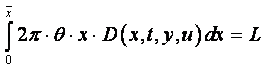
- The extent of urban land use is determined by the condition:
|
|
12
|
- Finally, equilibrium requires:
- The model provides a solution for the extent of urban land use as a
function of
- Population
- Income
- Agricultural land value
- Transportation cost
- If we generalize to include an export sector, then urban land use will
also depend on
- MP of land in goods production
- World price of the export good
|
|
13
|
|
|
14
|
- We consider three classes of models
- Linear models of urban land cover
- Linear models of the change in urban land cover
- Log-linear models of urban land cover
- Each approach has different relative merits
- Linear models – simplicity and sample size
- Change in urban land use – endogeneity
- Log linear – interaction and capture of non-linear impact
|
|
15
|
|
|
16
|
|
|
17
|
|
|
18
|
|
|
19
|
|
|
20
|
|
|
21
|
|
|
22
|
- Policies designed to limit urban expansion have tended to focus on a few
variables
- Transportation costs and modal choice
- Combat “car culture”
- Provide mass transit alternatives
- Limit road building
- Rural to urban migration and population growth
- Enhance economic opportunity in rural areas
- Residence permits for cities
- Considerable urban expansion occurs naturally as a result of economic
growth
- Limiting migration could be effective but ...
- Economic costs
- Consistency with guarantees of free mobility
- Regulation on use of groundwater combined with limits on infrastructure
provision might prove effective
|
|
23
|
- Many issues to confront
- Endogeneity
- Effectiveness of planning policies
- Availability of housing finance
- Evaluation of impacts of urban expansion
- In progress
- Field research to collect data
- Evaluation of classification accuracy
- Modeling at micro-scale – transition from non-urban to urban state
- Interaction with other local development
|

 Notes
Notes