
Laughter as Modulator of Stress: Lefcourt et al. Study
Undergraduates, solicited with posters and paid $20 for participation, were assessed with two different humor scales. The Coping Humor Scale (CHS) was used to determine intentional use of humor to cope with stressful events, while the Situational Humor Response Questionnaire (SHRQ) evaluated potential for humor, or how often humor was exhibited in response to situations varying in capacity to evoke humor. Subjects then underwent the following tasks: (1) an interview to determine "Type A" personality, stressful because the interviewer asked questions in a challenging manner, (2) the Favorable Impressions (FI) task, in which subjects attempt to impress a member of the opposite sex who does not respond, (3) the Cold Pressor (CP) task, which requires immersion of one arm into ice cold water, (4) the Mental Arithmetic Task, involving serial subtractions, and (5) the Stroop Color-Word test, in which subjects read colors that are written in conflicting colors. Blood pressure measurements were taken before, immediately after (during), and three minutes after completing the task (Lefcourt et al., 1997).
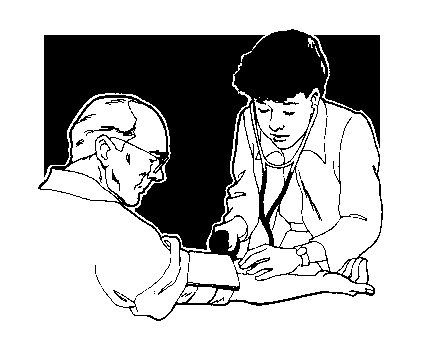
Lefcourt et al. obtained several significant results (1997). Overall, higher CHS and SHRQ scores correlated with lower systolic blood pressures (SBPs) among females for each of the stressful tasks. In males, higher SBPs correlated with high CHS scores in four of five tasks, but no relationship was found with SHRQ scores. Following the CP task, males with high CHS and SHRQ scores had smaller elevations in response to stress than did males with low CHS scores. The opposite relationship was found between CHS scores and SBP and no relationship existed between SHRQ and SBP on the MA test. Lefcourt et al. suggest that these results task may be due to increased effort by the men during this task, as blood pressure correlates with effort (1997). Finally, females showed no differences in SBP elevation levels based on CHS or SHRQ scores. Similar but smaller results were found for diastolic blood pressure. These results indicate different effects of humor on stress for men and women. Humor lowers the blood pressure of women overall, but has no moderating effect in response to stress. For men, however, humor does modulate stress, reducing the elevation of blood pressure in response to stressful situations. Lefcourt et al. propose that the observed differences between men and women may be due to the type of humor employed by the two sexes, wit or hostile humor and "self-deprecating" or adaptive humor, respectively (1997). Regardless, this study indicates that humor is positively related to blood pressure, either moderating it during stress or lowering levels overall.

Alternative Medicine | Laughter
Laughter as a Stress Modulator | Physiologic Effects of Laughter | Applications of Humor in Medicine