NEWBORN OUTCOMES: "CRACK BABIES"
Newborn Outcome:
°Decrease in birth weight and head circumference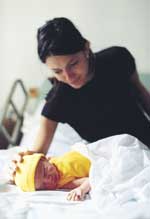
°Symmetric pattern of growth retardation-depressed
fat stores and lean body mass
°Increase fetal metabolism and thus cause
depletion of fetal nutrient stores,
leading to fetal malnutrition
°Postneonatal exposure to cocaine has been
reported via breast feeding, by
direct ingestion, and by passive inhalation
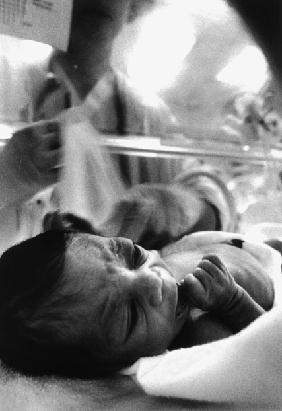
• Exposed to the drug in the womb and born addicted to crack cocaine, this child experiences severe withdrawal symptoms. Conservative estimates suggest that at least 11 percent of all newborns in the United States today were exposed in the womb to one or more illicit drugs. The number is even higher in urban areas. Birth and hospitalization of a normal newborn cost approximately $2,000. Birth and hospital care of a crack exposed neonate, with round-the-clock nursing, monitors, blood and urine tests, high-tech equipment and social service evaluations, costs $11,000. Who pays the bill? The government, since crack-addicted mothers are unlikely to carry insurance.
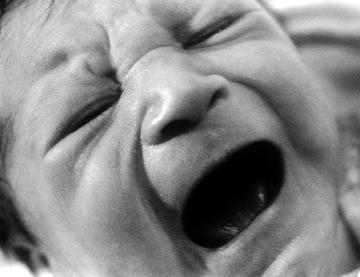 •
Prenatally drug -exposed newborns cry more frequently than unexposed babies.
This 'at-risk' baby suffering though moderate to severe withdrawal, was hard
to console. Typically, these children, when held, tend to arch their backs,
pull away and cry until they exhaust themselves. Experts note that these behaviors
interfere with child-parent bonding. "The worst problem in working with
these babies is that they have the jitters," says Nancy Shatz, a San
Francisco General nurse who works extensively with prenatally drug-exposed
newborns. "They cry because they are in pain and suffering," she
observes. "They don't even like to be touched.
•
Prenatally drug -exposed newborns cry more frequently than unexposed babies.
This 'at-risk' baby suffering though moderate to severe withdrawal, was hard
to console. Typically, these children, when held, tend to arch their backs,
pull away and cry until they exhaust themselves. Experts note that these behaviors
interfere with child-parent bonding. "The worst problem in working with
these babies is that they have the jitters," says Nancy Shatz, a San
Francisco General nurse who works extensively with prenatally drug-exposed
newborns. "They cry because they are in pain and suffering," she
observes. "They don't even like to be touched.
• Danny B, one day old, is a crack addict.
Swaddled in his soft hospital blankets, he spends each moment of his new life
struggling through painful drug withdrawal. Delivered prematurely at San Francisco
General 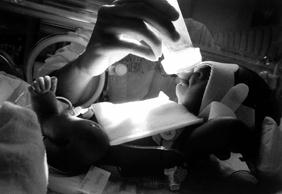 Hospital, Danny suffers from low birth weight and smaller-than-normal head
size. He rubs his face against the sheets in his isolette until the end of
his nose is red and chapped. He furls his brow and continually yawns, sneezes
and cries. Danny's high, shrill cry is different from that of other babies
in the nursery. "The cry is high-pitched, and sounds so urgent,"
explains Liza Fernandez, acting head nurse at San Francisco General Hospital's
nursery. "Drug-exposed children cry louder and more often than normal
newborns."
Hospital, Danny suffers from low birth weight and smaller-than-normal head
size. He rubs his face against the sheets in his isolette until the end of
his nose is red and chapped. He furls his brow and continually yawns, sneezes
and cries. Danny's high, shrill cry is different from that of other babies
in the nursery. "The cry is high-pitched, and sounds so urgent,"
explains Liza Fernandez, acting head nurse at San Francisco General Hospital's
nursery. "Drug-exposed children cry louder and more often than normal
newborns."
The Parent Child Intervention Program is a preschool
in East Palo Alto, California, established specifically to help prenatally
drug-exposed youngsters. Teachers try to provide a carefully monitored and
highly structured environment for the students. Here, a teacher's instructional
aide, Inga Garland, intervenes to 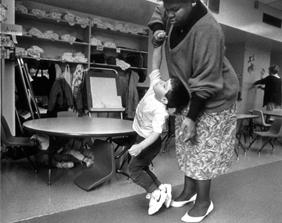 control
a child who has just kicked a classmate. Teachers report that cocaine-exposed
children are unable to deal with many different stimuli at once and tend to
act out aggressively or withdraw completely when overstimulated.
control
a child who has just kicked a classmate. Teachers report that cocaine-exposed
children are unable to deal with many different stimuli at once and tend to
act out aggressively or withdraw completely when overstimulated.
Many may recall that "crack babies," or babies born to mothers who used cocaine while pregnant, were written off by many a decade ago as a lost generation. They were predicted to suffer from severe, irreversible damage, including reduced intelligence and social skills. It was later found that this was a gross exaggeration.
 *Most
crack-exposed babies appear to recover quite well.*
*Most
crack-exposed babies appear to recover quite well.*
back to main "Prenatal Effects & Postnatal Outcomes of Cocaine Exposure" page
