Sleep terrors (STs) are a type of parasomnia that is found more frequently
in children than adults.
Young
children are more likely to have sleep terrors when the are tired, while
older children tend to experience them concurrently with a medical problem
such as an ear infection (www.drkutner.com/articles/nightmare.html).
They
are typically experienced in the first third of the night.
During
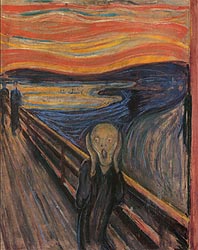
an episode of ST, a patient will sit up and emit a bloodcurdling scream.
He will experience tachycardia (increased heart rate), tremors and sweating.
He may flail his limbs.
Despite
the appearance of being awake, the patient is not awake and alert to his
surroundings.
ST’s
mainly occur during slow wave sleep (NREM sleep) and are quite frequently
within the first or second NREM sleep cycle (Espa
et al. 2000).
Thus,
STs are not to be confused with nightmares, as they are not associated with
REM
sleep, and a patient will not remember experiencing them when he awakes
in the morning.
Sleepwalking
Sleepwalking
is often called somnambulism, and is another well-known parasomnia.
Like STs,
it is more common among children than adults, but is still found in all
age categories.
Episodes
of sleepwalking usually occur around 1-3 hours after sleep onset (Espa
et al., 2000).
Most
episodes are brief, and not dangerous, however, the possibility of unintended
self-harm is always a concern.
Sleepwalking,
like night terrors, is an NREM sleep disorder.
Patients
with RBD act out their dreams; a clear sign of neurological dysfunction
as movement is generally inhibited during REM sleep to prevent violent physical
motion during dreaming (www.sleepfoundation.org/1).
In
a study in which lesions were made to cat brains in the center that controls
locomotion, cats displayed symptoms of RBD, suggesting this is the source
of the dysfunction (www.sleepfoundation.org/1).
Patients
with RBD engage in a variety of activities associated with waking, including
talking, shouting, screaming, hitting, or punching.
The
disorder is generally diagnosed when the person injures himself or his bed
partner while asleep.
.gif)