Current Research
The positive effects of touch therapy on growth and development were first demonstrated in rat pups. Previously, studies have shown that even short-term separation of infant rat pups from their mothers produces a series of adverse effects on the pups, such as a reduction in ornithine decarboxylase (ODC) activity, an index of cell growth and differentiation, and in the secretion of growth hormone, as well as an increase in the secretion of corticosterone (in Pauk, Kuhn, Field, & Schanberg, 1986). It was further shown that these effects were not related to changes in nutritional factors or temperature regulation, but were a result from a lack of maternal stimulation, and these effects of maternal deprivation can be reversed by tactile stimulation in the form of heavy strokes (Pauk et al., 1986).
Such heavy strokes include three different sensory stimuli: tactile, vestibular, and kinesthetic. In a study by Pauk and his colleagues (1986), they further showed that it is only the tactile interaction that is the key to reversing these adverse effects. They took rat pups and randomly assigned to one of five groups: control, deprived, deprived + tactile stimulation, deprived + vestibular stimulation, or deprived + kinesthetic stimulation. Tactile stimulation involves giving short, heavy strokes to the pups with a moistened, small hair-brush (that imitates the motherÕs licking) 10-20 times on the back and head. Vestibular stimulation was provided by rotating the pupsÕ container to a 45 degree angle and back to a horizontal position 6 times over a 30-second period every five minutes. For the kinesthetic stimulation, the pupsÕ limbs were gently manipulated (flexion and extension of the limbs) by hand for a 20-30 second period every five minutes. The pups were then sacrificed and the levels of ODC activity, growth hormone, and corticosterone were measured. The researchers found that only tactile stimulation restored normal physiology of maternally deprived rat pup (neither vestibular nor kinesthetic stimulation had an effect). This study also supports earlier findings that touch effectively contributes to the regulation and ODC activity during early rat development. This further lends support to the idea that tactile stimulation may also have such effects on early infant development.

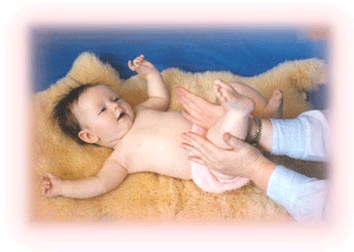
Indeed, in another study, Field and her colleagues (1986) has demonstrated that preterm neonates who were given tactile/kinesthetic stimulation (consisting of three, 15 minute periods per day for 10 days) averaged a 47% greater weight gain per day, were more active and alert during sleep-wake cycle behavior observations, and showed more mature habituations, orientation, motor, and range of state behavior on the Brazelton scale than control infants. Their hospital stay was also 6 days shorter, yielding a cost savings of about $3000 per infant. Researchers have proposed that a potential underlying mechanism for the weight gain: massage therapy perhaps lead to higher levels of food absorption hormones potentially mediated by vagal activity, and vagal activity has been demonstrated to increase during massage therapy (in Field, 1998). In any case, the data thus suggests that preterm neonates benefit from tactile/kinesthetic stimulation administered during their stay in a transitional care nursery setting. Such intervention is also a cost-effective way of facilitating growth and behavioral organization in even very small preterm neonates.

The benefits of massage therapy have also been demonstrated in full-term infants. In a study conducted by Field et. al (1996), forty full-term 1- to 3-months-old infants born to depressed adolescent mothers who were of low socioeconomic status and single parents were given 15 minute of either massage or rocking for two days per week for a six-week period. The researchers found that in terms of immediate effects of massage, babies who were given massages spent more time in active alert states and less time in drowsy states compared to the rocking group. Their crying and salivary cortisol levels also decreased while that of the rocking group remained the same. In addition, they spent less time in an awake state after the massage-therapy session, suggesting that massage may be more effective than rocking for inducing sleep. In terms of long terms effects, the infants in the massage group gained weight, improved on temperament dimensions such as emotionality, sociability, and soothability, and experienced decreases in urinary catecholamine and cortisol levels and increased serotonin levels. The data indicates that massage therapy may enhance the behavior and development of infants of depressed mothers.
In yet another study by Field, Seligman, Scafidi, and Schanberg (1996), they showed that massage therapy helps to alleviate posttraumatic stress (PTSD) in children following Hurricane Andrew. Sixty grade-school children who exhibited classroom behavior problems following Hurricane Andrew were given massage therapy on 8 days 1 month after the hurricane. Compared to a video attention control group, the children in the massage therapy group were found to be experience less anxiety and had lower salivary cortisol levels after the therapy. The benefits were evident on several different levels including self-report scores on anxiety and depression measures, drawings, behavioral observation, and biochemical assays. These positive effects of massage therapy again suggest that such cost-effective treatment could be taught to parents to help alleviate symptoms of PTSD after a traumatic experience.
Even though the foregoing discussion has focused on the therapeutic effects of massage on development, not only children have been found to benefit from massage therapy. Adults suffering from traumatically induced spinal pain have also been demonstrated to experience reduced chronic pain after massage therapy (in Cook, 1999). Another study also showed that massage therapy produced relaxation in elderly participants (in Cook, 1999).
All in all, massage therapy has been shown to facilitate growth, reduce pain, increasing alertness, reducing depression, and enhancing immune function. The diversity and breadth of applications of massage therapy suggest a wide range of possibilities for future research.