"Better Than Well"
What does it mean to be normal?
If wellness is what we are constantly striving for in our health, our attitudes and our emotions, is it possible to be better than well? Many Prozac users claim that they feel "better than ever" and that they are "more like [their] true self" (Breggin, 1994). But what is this saying about the true self that we strive for today? It seems as though it has become unacceptable in our culture to ever be sad. Doctors prescribe antidepressants as if sadness were an unnatural feeling that suddenly, with this generation, is impossible for a person to escape without drugs. The moment anyone feels slighty down she is prescribed antidepressants for a chemical "jump start".
With easy and almost expected access to antidepressants, we are setting the standard for "well" so high that we are losing that natural human emotion which is a necessary response to many situations. Consider for a moment that sadness did not exist. Now consider what would happen to happiness, love, empathy and other satisfying emotions. They too would disappear. Without the contrast between emotions, happiness loses its meaning. The change in our society's view of normal as a result to the serotonin revolution has the potential to seriously deflate and desensitize real emotions.
Why is it all of a sudden OK
for us to feel better than well on a drug?
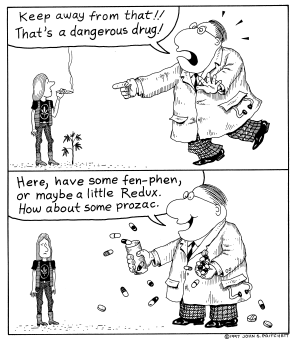 In the pre-Prozac past, the kinds of drugs that made a person feel "better
than well" were condemned, vilified, and outlawed. Various antidepressants,
however, particularly Effexor, have been likened to cocaine and amphetamine
in that they both block the reuptake of the same neurotransmitters in your
brain: serotonin, norepinephrine and dopamine (Breggin,
1994). Considering this, it is ironic that we are so concerned with illegal
drug use when it is frequently for the same purpose and with the same effects
as our good ol' friend Prozac.
In the pre-Prozac past, the kinds of drugs that made a person feel "better
than well" were condemned, vilified, and outlawed. Various antidepressants,
however, particularly Effexor, have been likened to cocaine and amphetamine
in that they both block the reuptake of the same neurotransmitters in your
brain: serotonin, norepinephrine and dopamine (Breggin,
1994). Considering this, it is ironic that we are so concerned with illegal
drug use when it is frequently for the same purpose and with the same effects
as our good ol' friend Prozac.
We still today are extremely concerned with drug use. Yet America's drug problem has become a different one. We have moved from teaching our children the motto "Just Say No to Drugs" to teaching them the idea of "take this drug to improve your life" (Breggin, 1994). In doing so, our drug problem has become that, as a society, we have this idea that drugs are the answer to feeling better than you ever could naturally.
Antidepressants have become so common that those people we used to consider "normal" can and are now taking antidepressants simply for the extra "punch". Some people argue that Prozac may be allowing for an unfair advantage in the workplace to those taking it because of the increased "alertness and drive" it provides (Breggin, 1994). Antidepressants were originally prescribed for clinically depressed patients who needed chemicals regulated in their brains in order to function at a "normal" level. These drugs are intended to make a depressed person not depressed, not to make a normally functioning human being into an overly happy Superman.