 Circadian Rhythm

 Circadian
rhythms are the fluctuations in mental and physical activities of an organism
that occur at approximately 24-hour intervals.
Circadian
rhythms are the fluctuations in mental and physical activities of an organism
that occur at approximately 24-hour intervals.
They
exist in even the lowliest one-celled plants and animals and are generally
controlled by the body’s biological clock, the suprachiasmatic nucleus
(SCN) (Hobson 1989).
 The
SCN is in the hypothalamus, (a part of the brain), and consists
of approximately 20,000 neurons (ninds.nih.gov).
The
SCN is in the hypothalamus, (a part of the brain), and consists
of approximately 20,000 neurons (ninds.nih.gov).
Signals
from the SCN travel to several different regions of the brain, one of
which, the pineal gland, responds to light by switching on and
off production of the hormone melatonin.
 Melatonin
levels increase after darkness falls, stimulating feelings of drowsiness
(ninds.nih.gov).
Melatonin
levels increase after darkness falls, stimulating feelings of drowsiness
(ninds.nih.gov).
The
SCN also controls alterations in physiology that accompany the sleep/wake
cycle such as body temperature, hormone secretion, and changes in blood
pressure. (ninds.nih.gov).
Our
circadian rhythm is primarily internally controlled, however we often
utilize external cues, such as alarm clocks or sunrise and sunset, to
plan our sleep/wake cycle. These cues are known as zeitgebers
("time givers").
Jürgen Aschoff performed
a famous study to determine that the cir cadian rhythm is controlled internally:
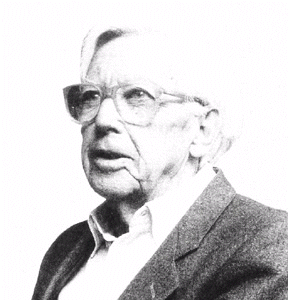
Pictured Above: Aschoff sourrce:www.cbt.virginia.edu/tutorial/SLEEPWAKE1.html